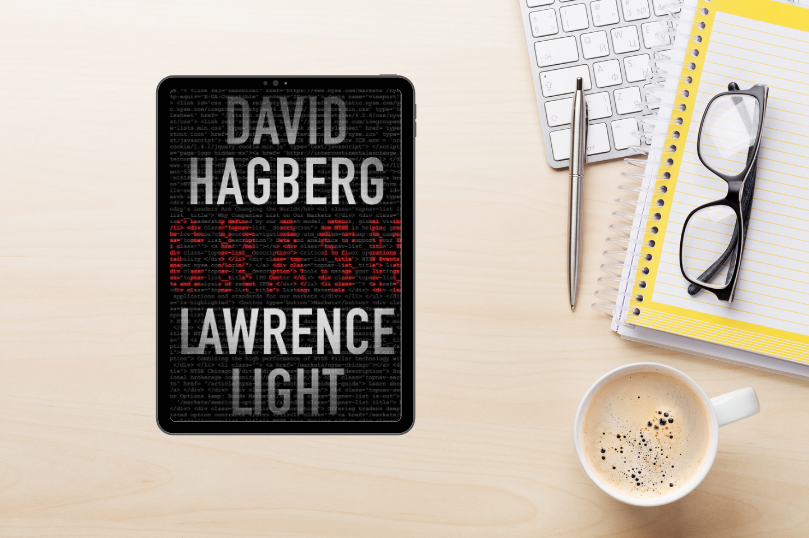
The second Great Depression is coming. The worldâs economies are groaning under too much debt. If one thing goes wrong, the entire rickety system collapses. Now, acclaimed award-winning New York Times bestselling novelist David Hagberg and renowned financial reporter Lawrence Light have combined forces to dramatizeâhour by hourâhow this all-too-real catastrophe could go down in Crash.
With debt-burdened governments and businesses worldwide about to go bust, a cabal of Wall Street big shots plot to destroy the globeâs stock exchanges. To provide that one thing that goes wrong. In 24 hours, a powerful computer worm will smash the exchanges and spark an international panic, pushing a debt-laden world into the abyss. The Wall Street gangâs investment bank will be the last one standing, able to make a killing amid the ruins.
But one person, who works for their bank as a computer expert, spots the worm embedded deep in its network. Cassy Levin invents a program to destroy the cyber-intruder. Angered by Cassyâs discovery, her bosses order her kidnapping.
Her boyfriend, a former Navy SEAL, is alarmed at Cassyâs disappearance and unravels the plot. Ben Whalen only has until the next morning to save the woman he loves and prevent the economic apocalypse.
This story is based on the genuine threat posed by towering debt, which will make the 2008 financial crisis look puny.
Crash will be available on April 28, 2020. Please enjoy the following excerpt.
1
Ben Whalen had known for the past two weeks that something was eating at his girlfriend, Cassy Levin, and he was almost certain it had to do with her work on the cybersecurity floor at Burnham Pike, the nationâs premier investment bank. But he had mostly left her alone about it, figuring that sooner or later she would tell him.
As a former Navy SEAL lieutenant he had learned by combat experience how to face any problem head-on. Not that he appeared very aggressive. At five-ten and a lean 170 pounds, his blond hair and open blue eyes made him look more like the appealing boy next door than a highly trained killer.
âMy hero,â Cassy had called him from the first moment theyâd met at Toniâs, a bar on Long Island
She was thirty, petite with a pretty face and a nice figure, and he was turning thirty-two next week, and sometimes, like this Thursday morning, looking at her lying in bed beside him in their third-floor loft in the Village, he could only marvel at his good luck. Theyâd lived together for nearly a year now, and on the fifteenth, his birthday, he was going to ask her to marry him. And it scared the hell out of him that she might say no.
Sheâd been moody lately, which wasnât like her. She was usually feisty and spirited, but something was bothering her, yet every time heâd brought it up sheâd just smiled and looked away for a moment. âItâs work, but I canât talk about it right now. Okay, sweetheart?â
âWhen?â heâd pressed two days ago as they were having lunch at the Old Town Bar on Eighteenth Street.
She started to object, the corners of her mouth turned down, but he kept going.
âIs it like Murphy Tweed?â
âDonât push it, Ben, please.â
âIs there an intrusion?â
âCould be,â sheâd said, and sheâd abruptly tossed down her napkin. âIâm late.â She got up, pecked him on the cheek, and left.
At her previous job over at Murphy Tweed, a small investments firm, she had worked as a cybersecurity analyst and designer. On her first day of work sheâd prepared a detailed report for the brass that their data systems was woefully out of date and prime picking for hackers. Sheâd recommended a complete overhaul of the system, which at her best estimate would take as much as a half million dollars to put in place.
She was voted down, and less than a month later, the companyâs system had been hacked, and mined for the user names and passwords of nearly one thousand customers. The stolen money had been channeled to overseas private banks where no one could find it.
âCould be,â sheâd said, and sheâd abruptly tossed down her napkin. âIâm late.â She got up, pecked him on the cheek, and left.
In less than ninety days the company had gone belly up, the execs bailed out with golden parachutes, and Cassy been blamed for the entire mess. She found herself out on the street with no job, no money, and no real prospects.
Until Francis Masters, a research chief at Burnham Pike, had recognized her talent and almost literally plucked her off the street.
âI would like you to do for us what you tried to do over at Murphy Tweed,â heâd told her in his office. âYou have the chops, Wharton and Harvard. I went to MIT myself. And believe it or not, MITâs old VP Tom Foley gave you the best recommendation of all: âHire her and listen to her.ââ
âMalware,â sheâd told Ben, at Old Town Bar. âSomeone put a program into our system that can steal passwords and user names, like at Murphy Tweed, and create all kinds of other mischief.â
âI know how to blow up stuff, and shoot bad guys, and seek and find.â
âMacho man.â
Heâd shrugged. âI didnât have Wharton or Harvard, but I did have the SEALs, including hell week,â he said. âBut you know how to stop it?â
Sheâd tilted her head to one sideâa move that meant she was agreeing with him and thinking at the same timeâa move that had turned him on from the get-go. âI think I do, and now itâs up to me to convince Francis so he can convince his boss, the chief technology officer.â
âOâConnell?â
âYeah.â
âWell, they hired you to improve their cybersecurity operation, so youâd think theyâd listen to you.â
âWeâll see.â
For the last week or so heâd watched the worry lines grow at the corners of her eyes and mouth, and her laugh, which had always been light and musicalâone of her many fabulous attributesâgo south.
âScrew it,â heâd said at their apartment yesterday after work. âYour systems are in place, letâs take a month off. Paris, get a little efficiency on the Left Bank, walk the Quai, spend the afternoons at sidewalk cafĂ©s, maybe take in a museum or two here and there. Versailles, Mont Saint-Michel, maybe a canal barge in Burgundy.â
âNot now,â sheâd said.
âLater?â heâd asked.
âPromise.â
He was going to propose in Paris. All he had to do was get her there.
2
Cassy came awake slowly, as she did most mornings. He watched her with pleasure as she stretched, arching her back, tasting her lips as if she were testing the air, just like a cat did, smiling, almost purring. Her shoulder-length dark hair was tousled, the sheet down, exposing one small breast.
Her eyes opened and she looked up at him, propped up on one elbow, watching her. âWhat?â she asked, smiling.
âI canât stop looking at you.â
âIâm a wreck at this hour.â
âMy wreck,â he said and he reached for her.
She pushed back the covers and scrambled out of bed, stepping back. âNot this morning.â
âWe have time,â Ben said and he shoved back his covers and started to get up.
âBenjamin, no,â she screeched, backing up.
They both slept in the nude, and in his eyes every square inch of her body was perfect. And again as he did just about every hour of every day he said a Hail Mary to his luck. He was a kid from the wrong end of a steel plant/iron-ore-mining town, and she was a New England privileged blue blood.
âJust a shower together. One reason why not.â
âIâll give you two. Youâre taking the shuttle down to the Navy Yard in D.C. first thing, and in the meantime the roof might cave in on me this morning so I have to be on the floor ASAP.â
âCome on, Cassy. Itâs me youâre talking to. Whatâs going on?â
âSomething, Iâm not sure. But big.â
Her narrow shoulders slumped, and for just a moment Ben thought that she was going to cry.
He got out of bed, and before she could turn away, he took her in his arms. She was shivering and he held her without saying a word for a long time until she calmed down. When they parted she looked up at him.
âIâm afraid.â
Why would he say âDonât beâ if heâs so concerned about her?
âDonât be, Iâm here.â
âJust be here for me, Ben. Please. Promise me that no matter what happens in the next twenty-four hours or so, be there.â
âPromise,â he said, and he was more concerned than heâd ever been in a combat situation, where the SEALsâ number-one Murphyâs law was: Incoming rounds have the right of way.
3
Clyde Dammerman, the number-two man at Burnham Pike, was the last of the four to arrive at Kittredge, the hundred-year-old private club on Fifth Avenue. He was a tall man with a bald head, a beak of a nose, and dark, angry eyes that suited his personality. This morning, an hour and a half before the opening bell on the NYSE, they were the only four in the oak-paneled dining room on the third floor.
Reid Treadwell looked up. He was BPâs chief executive officer, a trim, dapper man in his fifties with gray hair. The joke was that he was so natty he even went to bed at night dressed in a three-piece suit, the tie correctly knotted. Handsome and debonair, he radiated a charisma that landed Burnham Pike a lot of high-fee dealsâand aided his almost insatiable quest for women. Always calm and composed in public, he never raised his voice even when he was irritated, like now. âYouâre late,â he said, his tone icy but even.
Dammerman, whose idea for the crash had come to him in a dream eight months ago, took his seat. âSorry, Mr. T, traffic.â
âWeâre betting the fucking farm on this thing, so you could at least be on time.â
âWeâre on point, trust me. By noon tomorrow each of the four of us will have become heroes, and on our way to collecting several-hundred-million-dollar payouts and the grateful thanks not only of BP, but of the few clients who will have listened.â
âAnd screw the NYSE, and every other market across the country and the pond,â Spencer Nast, whoâd come up from Washington on the train last night, said, with a smirk on his pinched, narrow little face. His hair was thin, his frame was thin, and so, in everyoneâs opinion, were his morals. Everyone except for President Roland Farmer, a multibillionaire businessman whoâd hired Nasty, as Spencer was widely known, to be the White House chief adviser on economic affairs.
âStart a business, get into the markets, take a risk, and sometimes you win, sometimes you lose,â Dammerman said. âThis time we win, guaranteed.â
âLots of people are going to get fucked,â Nasty said.
âBut not us,â Dammerman replied. âNot us, not this time.â
Treadwell, who had listened without comment, sat forward. âJulia, weâre down to the actual wire here, whatâs your take? Go or no go?â
Julia OâConnell was BPâs chief technology officer, and without her brilliance, the Plan, as the four of them had come to call the scheme, wouldnât have a chance of working. Pleasant but socially maladroit, like many tech geeks, she was obviously trying to assume a tone of bravado among all these high-testosterone males.
âItâs risky,â she said. A five-two, just over one hundred pounds, with dark hair cut in bangs, she epitomized the computer whiz. Sheâd been a nerdy genius since she was seven years old, when she first discovered that she understood the cyberworld. She knew what computers and complicated programs were thinking. Even what they were feeling. Her babies were pure, in her mind, angelic. The gods of a new age. They could do no wrong if they were handled with a velvet glove. Garbage in, garbage out. The mantra for the new age.
âIs it a go?â Treadwell repeated.
âAbacus is a go,â OâConnell said. âA better virus than Stuxnetâthe one that crashed Iranâs nuclear programâless traceable because it leaves no footprint, and so deadly complicated that even the best heads wonât be able to come up with the cause, let alone any solution thatâll work. When we crash the marketâand I mean crash itâtheyâll have to start over again. From day one, at tables under a tree on Wall Street.â
âItâll effect just about every other market here in the StatesâNasdaq, American Exchange, Chicago, Over the Counterâplus Tokyo, London, the Euronext, Shanghai,â Dammerman said. âThank you, Amsterdam.â He raised his coffee cup, and the others, including Treadwell, did the same.
âAmsterdam,â Treadwell repeated.
The fact of the matter was that when it came to serious cybersecurity issues, the most talented hackers were all mostly young, disaffected peopleâalmost hippiesâwho lived in communities in the slums of Amsterdam. The Russians went to them for help, as did the Chinese, the Brits, everyone. Including Dammerman, who with OâConnellâs help designed the parameters for Abacus, and handed the project over to the whiz kids,
And now within twenty-four hours, or a bit more, Abacus would be a reality, the final phases inserted into the NYSEâs computer system. Markets across the world would crash, disintegrating peopleâs faith in the system, and triggering defaults of debt in an overextended world financial system. The entire planet would plunge into a mind-numbing depression the likes of which hadnât been seen since the 1930s.
Treadwell raised a finger, and instantly a waitress appeared to take their breakfast orders. Omelets or easy-over with ham or bacon for everyone except OâConnell, who ordered oatmeal with half-and-half, plus yogurt and a dish of cut fruit.
âThank you, Denise,â Treadwell told the waitress, who blushed. He was a born salesman, who knew everyoneâs name.
âWho the hell do you think you are, Hank Paulson?â Dammerman asked, laughing. Paulson, whoâd been secretary of the treasury in 2008 during the collapse of the subprime mortgage market, had famous planning breakfasts with the president of the New York branch of the Federal Reserve, the chairman of the Fed, and the comptroller of the Currency, as they hustled to stem the crisis. He ate oatmeal every day for breakfast.
âIâm glad he isnât here,â OâConnell said.
No one laughed, because it was those four people whoâd averted what would have amounted to a collapse of the entire American economy and almost certainly the economies of every industrialized nation. They bailed out the big banks, averting a total collapse.
âThereâll be no bailout this time,â Treadwell said. âToo big to fail? We wonât give them the time to react. When they realize what has hit them, itâll all be over.â He smiled. âI wonder what theyâll call it once the dust settles?â
âHow about the debt bomb,â Nast said. He liked to lecture people about economics. âItâs the real reason the shit storm is coming, and thereâs nothing anyone, and I mean anyone, can do about it.â
There were four types of people in the financial worldâin places like Burnham Pike, the markets, and especially the White House: dealmakers, like Treadwell, who was the driving force at BP and a smooth operator. Traders, like Dammerman, with his blue-collar background, the same as most of the market makers who manned the posts on the floor of the NYSE. Geeks, like OâConnell, who understood computers better than she did people. And wonks, like Nast, who were the numbers jockeys, the guys who analyzed company finances, figured out elaborate market algorithms, and wrote economic forecastsâeverything heâd done for BP when heâd worked for the firm, and now did for POTUS.
âAnd weâre going to make a killing by getting into cash, because we know itâs coming,â Dammerman said, with a smirk.
âBecause we made it happen,â OâConnell agreed.
âAbacus is just the spark thatâs going to light a fire that would have come all on its own,â Nast said. âAnd thatâs the beauty of the thing. The world will go to shit and thereâll be no one to blame. Especially not us.â
âThe âdebt bomb,ââ Treadwell said. âI like it.â
âItâs easy,â Nast said. âThe world is in too much debt. Pushing the quadrillion-dollar mark. Hell, most countries will never be able to pay it back, and are having a hard time just keeping up with the interest.
âHere at home our debt is almost one hundred percent of the GDPâthe gross domestic product. When Social Security was put into place in the thirties there were forty-two workers for everyone who collected their monthly payment. Today itâs three to one, and that ratio is shrinking. Americans are living longer, and Medicareâs costs are spiraling out of control. So how to fund it? More debt.
âSince the last crisis corporate debt has gone through the roof. Companies right now owe more than six trillion dollars plus, because the Fed lowered interest rates, which added more fuel to the fire. But instead of expanding production and research, building new factories, hiring more workers, theyâre funding stock buybacks to make their investors happy.
âState and municipal pension plans are so underfunded thereâs no way in hell employers will be able to meet their obligations to their retirees, and thatâs already here, right now, in the short run.
âHousehold debt is in the stratosphere. Credit cards, houses, cars, college loans. Put together that adds up to another thirteen trillion dollars and counting.
âAnd just about every other country is in the same condition or worse. China is choking on debt. Greece is going down the tubes. And Latin Americaâs debt to us? Forget them everâand I mean everâpaying it back. Most of those countries are starting to default just on their interest payments.â
Nast stopped for a moment. âCrash the world economyâstarting with the NYSEâconvert to cash, and weâll make our fortunes, all right,â he said. âAnd live like kings.â
âOur virus Abacus will start the fire,â Treadwell said, âbut how do we know it canât be put out somehow? The NYSE has an off-site backup computer system. If the main servers on the floor fail, they can go to the second set.â
âI have it covered,â Dammerman said. âTrust me. No backup computer on the planet will save the market once we pull the pin. And our Russian friends will even plant a terrorist bomb on the backup computer just as a diversion.â He laughed, his voice loud in the normally staid dining room.
Breakfast was served by four waiters, and when they were gone, OâConnell spoke up.
âBut we may have a problem,â she said.
âWhat problem?â Treadwell asked,
âA woman in my department, a data scientist named Cassy Levin, is suspicious that something is wrong. She came to me last week, damned near on the verge of exposing Abacus.â
âIsnât she the dumb ass who brought down Murphy Tweed?â Dammerman asked.
âWasnât her fault,â OâConnell said. âAnd trust me, this gal is bright, very bright.â
âPut Francis Masters on it,â Treadwell said. Masters was BPâs number-two cyber-research chief, a onetime hacker himself. The in-house belief was that the man would stomp his own mother to death if Treadwell told him to do it.
âIâm just saying we need to be careful,â OâConnell said.
âMaybe sheâll have an accident,â Dammerman said.
Copyright © 2020 by David Hagberg and Lawrence Light
Pre-Order Your Copy