
To celebrate the release of opens in a new windowThe Tomb of Dragons, we asked Katherine Addison to share the five dragons that shaped her love for these legendary creatures. From classic literature to pop culture icons, these are the dragons that left a lasting mark on her storytelling.
by Katherine Addison
My book, opens in a new windowThe Tomb of Dragons, the third book in the Cemeteries of Amalo trilogy, comes out on March 11. Given the title, it will not be a surprise to anyone that the book contains…dragons. The dragons in this case happen to be dead (again, as the title suggests), but that does not make them any less central to the plot and themes of the book.
I had written short stories about dragons before:
opens in a new windowDraco campestris which is up at Strange Horizons; opens in a new windowAfter the Dragon, at Fantasy Magazine on the Psychopomp website; opens in a new windowLearning to See Dragons at Uncanny Magazine. But this was the first time they insinuated themselves into a novel. I found that dragons, like cats, immediately expand to fill all available space. Dragons, again like cats, have opinions and are not afraid to share them. I loved writing about them; the problem was generally confining them to one room, as it were.
And when I considered the matter, I realized that my love of dragons has deep roots. Let me offer you five snapshots:
ONE. Smaug.
Baby’s first dragon.
My maternal grandmother, of whom I have no memory, gave me The Hobbit for Christmas in 1980. I had just turned six. My dad read it to me multiple times.
Smaug is important to me in ways I actually find very difficult to articulate. He was not my introduction to the fantastic. I know I encountered The Sneetches and The Wonderful Wizard of Oz and There’s a Nightmare in my Closet and Where the Wild Things Are and The King with Six Friends and Sir Toby Jingle’s Beastly Journey and goodness knows how many other picture books that I no longer remember, before Christmas 1980. And the fact that Smaug (and Gollum and Mirkwood Forest) started my lifelong love of the works of J. R. R. Tolkien is true, but insufficient. Smaug is special to me in and of himself, and I’ve been wandering around the house for the past hour trying to figure out why.
Dragons are powerful. They are enormous. They can fly and breathe fire. (They are also impossible, as Terry Pratchett points out very kindly in Guards! Guards!) They can talk—you can have a conversation with a dragon, even if lurking behind every word is the knowledge that the dragon is planning to kill you. They take up a space in the imagination halfway between beast and person, tipping one way or the other depending on the artist. Maybe it’s the desire to talk to animals that makes dragons so appealing. (I read the Dr. Dolittle books as a kid, too, and loved anything with talking animals.)
Or maybe that’s not it at all.
ONE POINT FIVE.
Shout-out to Richard Boone, the voice of Smaug in Rankin Bass’s 1977 animated version of The Hobbit.
TWO. Mnementh.
A dragon is a girl’s best friend.
I was a horse-crazy little girl with very limited access to horses. Of course I read every horse book I could get my hands on, but the dragons of Anne McCaffrey’s Pern books scratched some of the same itch. (Plus, as mentioned of dragons above, they could fly and breathe fire.)
I remember distinctly that I did not want a queen. I wanted a dragon who could go out and do things. Plus, you know, a gigantic best friend who could just EAT people who were mean.
And a dragon as a best friend is really only a logical step further from a dragon you can talk to.
THREE. Yevaud.
For some reason, one of my English textbooks in junior high (that being what we had before “middle school” was invented) included “The Rule of Names” by Ursula K. LeGuin. I read that story SO MANY TIMES, both because I had a dearth of other reading material and because I loved it. I suspect that much of my own obsession with names comes from that story. Its world-building is amazing. And it has a magnificent dragon, hiding behind the prosaic shabbiness of Mr. Underhill.
It’s a LeGuin story, so there’s a lot going on, names and dragons and heroes (or “heroes”), and of course the hoary admonition not to judge a book by its cover, which LeGuin turns into something surprising and delightful.
FOUR. Maur.
Yes, the business with the dragon skull in The Tomb of Dragons is absolutely an homage to The Hero and the Crown, another story I read over and over. (Both a horse book and a dragon book!) Maur provides one of the great dragon fights in English literature, and is in some ways an even greater embodiment of evil than Smaug, since his evil does not dissipate, however slowly, after his death, but becomes invisible—indirect and insidious rather than the straight-out in-your-face fire-breathing evil that Aerin thinks she is prepared for. This more quiet evil, psychological rather than physical, was horrifying to me as a child and is horrifying to me now.
FIVE. Morkeleb.
I love Dragonsbane by Barbara Hambly for many reasons, but one of them is the idea that a dragon can be a character—not a human being, but nevertheless a person. The great dragon villains of my childhood—Smaug and Maur—are in fact great and terrible, but they aren’t characters in the way that Morkeleb is. (You could argue that one of the points of “The Rule of Names” is Yevaud’s desire to be a person in a way that he cannot be when he is a dragon.) Morkeleb is a non-human creature who struggles to understand what has happened to him when he falls in love with a human woman. (He is Not Happy about it, which is one of the reasons I love him.) Hambly writes characters with great empathy and deftness, and her dragon is no exception.
BONUS ROUND. Tiamat.
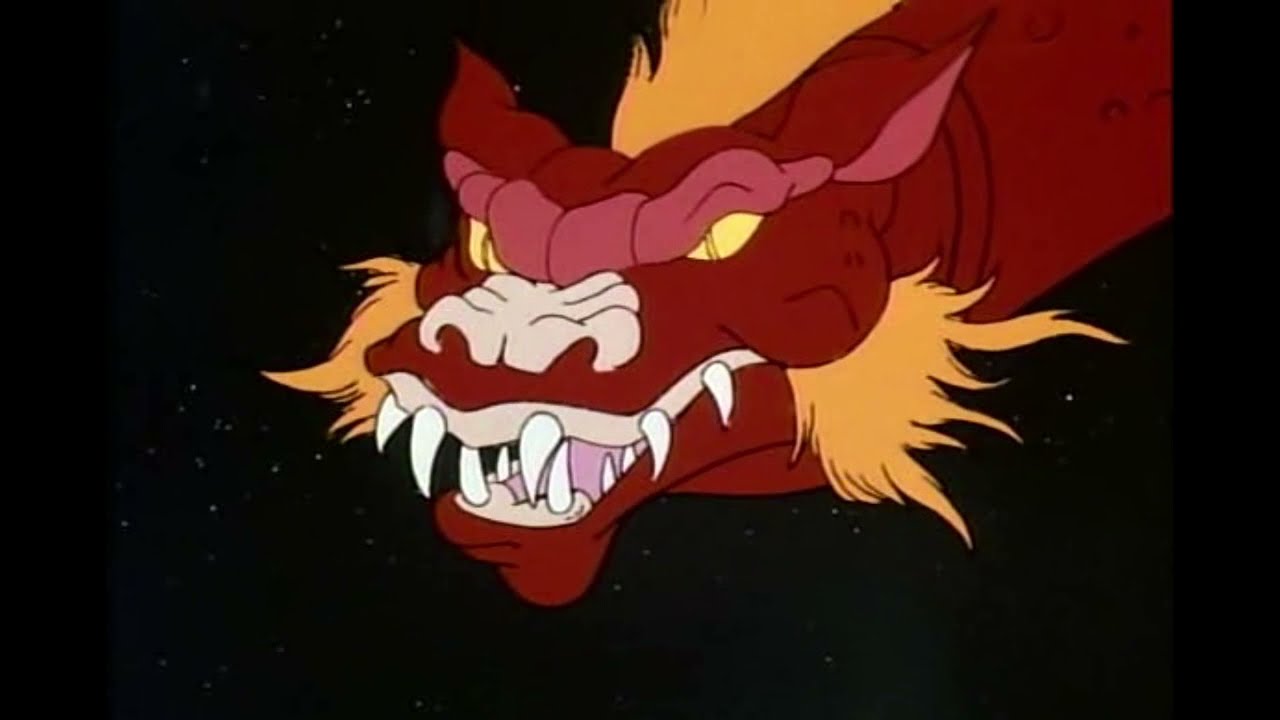
I watched Dungeons & Dragons faithfully every Saturday morning as a kid. (The IMDb tells me this happened from 1983 to 1985, so ages 8 to 10. Peak kiddom.) The premise of Dungeons & Dragons was that a group of friends inadvertently crossed into a world run by D&D rules (via the medium of a rather sketchy roller coaster). Each of them was involuntarily assigned into a character class. They found themselves in a world instantly recognizable to anyone who has played D&D—or Zork, for that matter. They got assigned quests by Dungeon Master, who was gnomic and smug and could disappear at will. They battled various villains and monsters. And Tiamat.
Tiamat was awesome. (The IMDb does not give anyone credit for her voice; Wikipedia tells me it was Frank Welker.) Not only did she have five heads, she was the only creature the main villain, Venger, feared. And she was a girl.
I was not a feminist in 1985. But I mostly didn’t like being a girl. (I would like it even less when puberty hit in 1986.) The things I liked doing were not “girl” things. They weren’t really “boy” things, either, but in the ‘80s, gender neutral defaulted to “boy.” I didn’t want to wear make-up. I didn’t care about pretty clothes. I wasn’t Interested In Boys. I wanted to read books about elves and vampires and aliens and scullery boys on quests and terrifying things living in the sewers of small Maine towns. I accepted as normal the fact that most of these books had male protagonists and male antagonists. But I loved books like The Hero and the Crown, with a female protagonist overcoming the limits of her gender role. And I loved Tiamat for being a dragon who was female. Not because her femininity was the point (it most certainly was not), but because she existed and was female and at no point did her femininity keep her from being monstrous and terrifying. She was a dragon, and I loved her for it.
Tiamat’s main head:
Tea with the Black Dragon by Roberta MacAvoy (There was a sequel too).
Ooooh I’m so happy to see Morkeleb on this list. I love him as well!
Same! Michael Whelan’s cover grabbed me in grade 7 and that began a lifelong love of fantasy books (I had some…reading restrictions imposed when I was younger). Morkeleb is the first thing I think of when I hear “dragon”.
Gotta shout out Kazul from Dealing with Dragons, my absolutely favourite childhood dragon
My favorite childhood dragon has to be another Tiamat, the dragon from Bruce Coville’s “Jeremy Thatcher, Dragon Hatcher.”