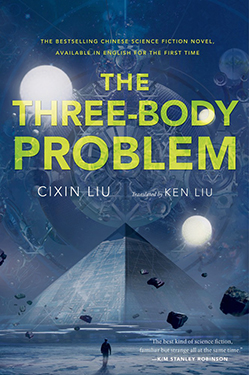
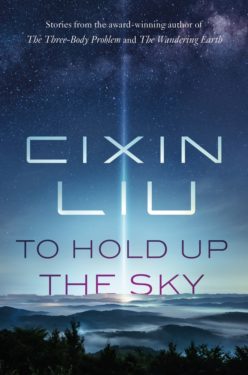
 Cixin Liu is the New York Times bestselling author of opens in a new windowThe Three-Body Problem, and we are so, so excited to see what he has in store for us with his latest work, opens in a new windowTo Hold Up the Sky. To celebrate this new release, we decided to interview some of the people who made it possible for us to read this book in English—the translators. From their greatest challenges to their favorite stories in the novel, check out what Carmen Yiling Yan, John Chu and Adam Lanphier had to say here!
What makes the stories in To Hold Up the Sky stand out to you as a translator?
Carmen Yiling Yan: What strikes me the most is the scope of imagination in these stories, the sense of astronomical scale. There’s truly a sense of wonder that I haven’t experienced in much other science fiction lately.
Adam Lanphier: I only translated The Village Teacher, so I’ll talk about that story. Among Liu Cixin’s Chinese readership, The Village Teacher tends to elicit superlatives, both positive (e.g. it’s his “most touching” story, “most humane,” “most real”) and negative (e.g. “softest,” “most sentimental,” “goofiest aliens”). I agree.
Trying to carry this story’s deft, earnest genre-play into English was a balancing act. For the story’s moral message to land, the village needs to be poignant, not lurid; the children need to be sympathetic, not schmaltzy; the teacher needs to be a hero, not a caricature. The aliens didn’t need much—goofy is goofy.
This is a special story to me, as it is to many of Liu Cixin’s fans. I worked hard to do it justice. I hope I succeeded.
What are the biggest challenges in translating science fiction?
Carmen Yiling Yan: One tricky aspect is getting the technical terminology right, especially on a topic that I’m not familiar with. For Full Spectrum Barrage Jamming, I was looking up army manuals and physics articles.
Adam Lanphier: I’ll tell you what isn’t the biggest challenge: the science. I am frequently surprised by how straightforward it is to translate detailed, technical passages, even speculative ones. The language of science is precise and objective, almost by definition; it’s simple to research (compared to history, say) and its terminology tends to strike a similar tone across languages. I imagine most languages have more ways to say “I love you” than “cold fusion.”
John Chu: One of the trickiest things about translating any story is that you’re really translating between cultures. As a translator, you are trying to have the same effect on the reader in the target language that the original author had on the reader in the source language. Two obvious areas that make things difficult are humor and profanity. As a translator, you have to find something that your reader will find just as funny or just as profane. Invariably, it’s not a ‘literal’ translation of what the original author wrote. What we find funny or profane is extremely culture-based.
In that light, I don’t know that the challenges in translating science fiction are all that different from translating a non-speculative story. There may be more elements to balance against each other. Science fiction has its share of technical language and made-up words, for example. Ultimately, it’s still about making the target language reader feel that same “sense of wonder”, for example, that the source language reader feels.
What are some marks of a story that’s been translated well?
Adam Lanphier: A well translated Chinese story, if it’s a story worth translating, will maintain a clear sense of space, direction, and location. In my experience, this is the ‘omelet test’ for translators of Chinese into English, as spatial language in Chinese, though precise, is unintuitive for English speakers and tricky to maintain convincingly in translation. What’s more, it often assume a reader’s familiarity with features of traditional Chinese architecture (e.g. a character might tell another to “go inside” when they’re already indoors, an abstract reference to the series of increasingly private courtyards that were once prevalent in Chinese buildings; one might render this as “go down the hall”) and society (e.g. an “outsider” may mean a stranger, a non-relation, a foreigner, or a layperson, depending on context. “Gentile” sometimes comes eerily close).
If I can’t whether we’re indoors or outdoors, or where a character’s other arm is, or where the magazine on the chair went, that’s a red flag.
Unless a Chinese story touches on biology or butchery, a good English translation will use the word “heart” no more than once every other page.
These are details. Like all translators, I’m a craftsperson, and like most, I’m a freelancer. I shouldn’t presume to offer a more thorough answer to your excellent, difficult question, whose meat I’ll leave Nabokov and Borges to fight over.
John Chu: I honestly don’t think you can tell whether a story has been translated well without doing an A/B comparison with the original text. For reasons not worth explaining, I’ve actually done this with _The Three Body Problem_ and _Death’s End_. (I’ve read _The Dark Forest_ in Chinese but not in English.) So I feel confident in saying that Ken Liu did a superb job with them. Lots of people think they want ‘literal’ translations and they really don’t. _The Three Body Problem_, particularly, is steeped in Chinese history and your typical American reader is not going to have as thorough a grounding in Chinese history as your typical Chinese reader. Ken does an excellent job making sure that someone who doesn’t have a Chinese history background reading in English has at least a similar understanding as a Chinese reader reading the original. There are any number of things in those books that don’t really translate directly, for example, puns. Ken always comes up with substitutes that fit seamlessly.
The things he did that make those translations work so well aren’t noticeable unless you compare back to the original. When you read the translation, what you’re reading is the combined effort of both the original author and the translator. And, honestly, when it comes to things like word choice and phrasing, it can be hard to figure out who did what. (Obviously, original author is solely responsible for stuff like plot.)
That said, the translator is always trying to give you the experience that someone reading in the original language gets. Whether the translator has done that is up to the reader.
What’s the top reason why English-speakers should read more translated fiction?
Carmen Yiling Yan: First and foremost, because there’s so much good stuff out there! Some of the best epic fantasies and historicals I’ve read have been in Chinese. And there’s entire trends and genres with no direct equivalence–I have a soft spot for escape room novels. People who don’t read translations are missing out.
John Chu: I think the wider the net you cast, the more likely you are to find interesting, excellent work. There’s amazing work being published every day and not all of it was originally written in English.
Order To Hold Up the Sky Here:
opens in a new window opens in a new window
 opens in a new window
 opens in a new window
 opens in a new window