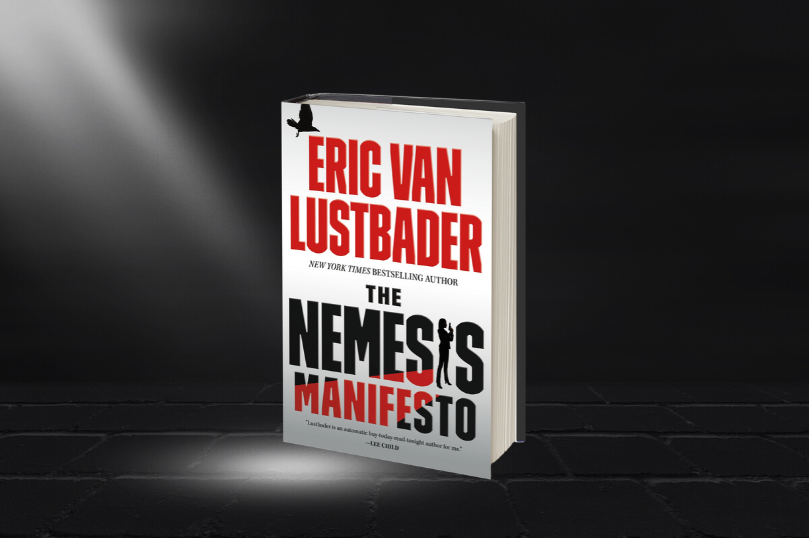
opens in a new windowThe Nemesis Manifesto is the start of Eric Van Lustbader’s newest action-packed series, but he hasn’t always been writing thrillers. Check out his guest post on starting his career writing fantasy novels, what it’s like to write both fantasies and thrillers!
By Eric Van Lustbader
I am often asked how I can successfully write both thrillers and fantasy. Of course, any question about creating contains elements that are simply inexplicable – because creating in any form — art, music, or in my case, writing is by definition inexplicable. It’s a gift, and that’s as far as I can take it in explanation.
I grew up immersed in both spy novels and science-fiction/fantasy. The first series I wrote way back in the ‘70s, The Sunset Warrior, was fantasy. It seemed the easier route when starting out because I could create the world from the ground up. When you create your own rules, as long as you stick to them, all the details come straight from your mind.
By the time I’d finished the five Sunset Warrior novels, I had realized why I had been drawn to both genres. In other words, the similarities, rather than the differences, started to come into focus. The main undercurrents of loyalty, reason, humanity, courage, and sacrifice that drew me personally to write characters driven by those ideals were the core values of both genres. While on the surface it doesn’t seem these two genres are in any way compatible, the fact is they are. I guess that’s why so many SF/Fantasy readers like thrillers so much. They’re just like me!
I’m often asked how I got into thrillers when I started out so successfully in the Fantasy genre. The answer has nothing to do with genre or style. In college, I became fascinated by Japanese book-block prints. I learned about the Ronin Gallery in Manhattan, and became friendly with the couple who owned it. I hung out at the gallery in much of my spare time and would often listen to and learn from the conversations I heard.
The time I spent at the gallery fired my writer’s imagination. I created a character for my next fantasy series called The Ninja based on what I learned. And yet, as successful as this series was, I did once again return to fantasy, which for me is a kind of sanctuary, a place of rest and repose that takes me back to my teenage years, when it was just about my only solace in a world I didn’t understand and which certainly didn’t understand me.
I had recently moved to a new publisher, which turned out to be such a big mistake I almost quit writing. One day, while I was cleaning out my office I came across a partial manuscript I had forgotten all about. It was the beginning of a fantasy novel, and I was so taken with it that I decided to finish it. Midway through that process I realized the story wouldn’t fit into one volume. My friend and publisher, Tom Doherty, bought The Pearl Saga series, saving my life and reigniting my belief in publishing. I’ve happily been with Tor/Forge ever since.
They’ve been with me through my many incarnations. Through the Jack McClure series, featuring a protagonist who, like me, is on the dyslexia spectrum, the quartet of The Testament novels, which straddled the line between thriller and literary horror, and now The Nemesis Manifesto, the first novel in a new series starring Evan Ryder, a field operative who is not superhuman, but lives by her wits and her instincts — relatable in every way to every kind of reader.
Once again, for me, a new beginning…
Order Your Copy:
opens in a new window opens in a new window
 opens in a new window
 opens in a new window
 opens in a new window


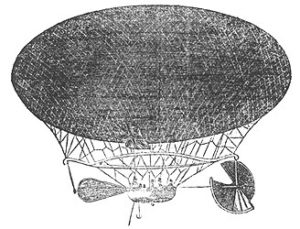
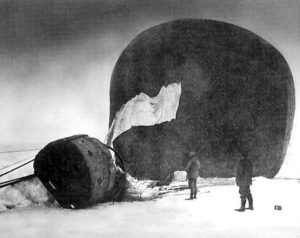 My drag rope idea, though similar on the surface, would prove to be anything but plausible. It turned out that a drag rope had already been tried in S. A. Andrée’s Arctic Balloon Expedition of 1897. Far from out-sailing seagoing vessels, Andrée reported that his balloon could only steer ten degrees from the direction of the wind, and modern experts believe that even this meager claim was an absurd exaggeration. Worse, the failure of their sailing scheme was a contributing factor to the deaths of all three expedition members.
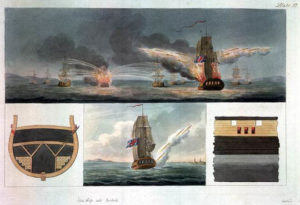 Broadsides of rocketry don’t have the satisfying thunder of cannons, and I could think of no plausible way of following my broadsides with a boarding action—and without a boarding action, a broadside just feels empty, doesn’t it?
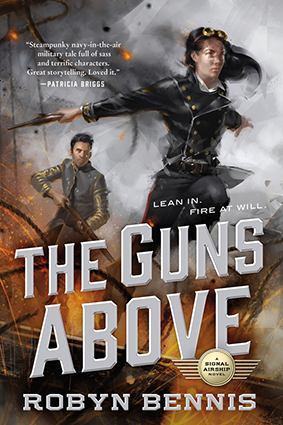
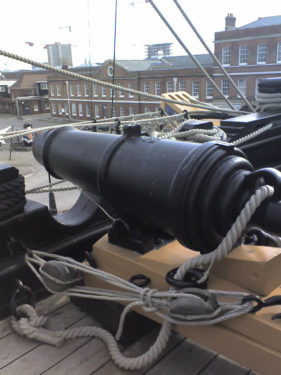 And you know what weighs about a ton and a half? Two twelve-pounder carronades, plus ammunition and minimum gun crews. I decided not to waste time or risk disappointment by rechecking my math, but proceeded straight to sketching out the placement and capabilities of what would become Mistral’s light cannons, or “bref guns.” Now, bref guns are still implausible for other reasons—we won’t even contemplate the real-world effect of their recoil on Mistral’s airframe—but let’s be frank here; if you can find the merest excuse to put cannons on your steampunk airship, you put cannons on your steampunk airship, or you’re a damn fool.